 Futura
Letter to Your Future Self for Students: A Lesson That Sticks
It's the classic first-week or senior-year assignment — and it usually fails at the last step: the letters never make it back. Here's the whole lesson, delivery included.
Why does this assignment work so well?
Three reasons teachers keep coming back to it. It's zero-stakes writing — the only reader is the writer, so reluctant writers stop performing and start saying things. It's built-in metacognition — describing yourself to a future audience forces the reflection that worksheets try to extract by force. And it has a payoff moment — opening the letters at year's end or at graduation is the rare assignment that produces genuine gasps. Two ground rules make it safe: the teacher never reads the letters, and content is never graded — completion only.
The 45-minute lesson plan
| Time | Segment | What happens |
|---|---|---|
| 0–5 min | Hook | Read one anonymized excerpt from a real (or your own) old letter. Ask: "What will Future You wish you'd written down today?" |
| 5–10 min | Brainstorm | Class builds a "today inventory" on the board: current price of a snack, the slang, the app of the month, the song everyone's sick of. |
| 10–30 min | Writing | Silent write, four sections: my life right now · what's hard · what I hope · questions for future me. Prompts below on the projector. |
| 30–38 min | Predictions | Everyone adds three predictions with confidence percentages — the section students race to check first when letters open. |
| 38–45 min | Sealing | Letters get sealed (envelope or app) and dated: end of year, or graduation day. Log completion only. |
Prompts by level
Elementary: What do you want to be when you grow up? Who is your best friend and what do you play? What's your favorite thing you made this year? Draw today. Middle school: What's something you're nervous about this year? What do you do after school, hour by hour? What are you proud of that adults don't notice? What do you hope is different by June? High school / seniors: What do you actually think you'll do after graduation — not the version you tell relatives? What's the current friendship-group map? What's a belief you suspect you'll change? What should Future You forgive Current You for?
The delivery problem (where it always breaks)
Every teacher who's run this has a drawer of orphaned envelopes: students transfer, folders migrate, the box gets lost in a classroom move — and a senior-year letter written in September needs to survive to a June four years away. Paper solutions leak. The fix is to make delivery automatic: each student seals the letter to their own future address, digitally, with the open date set to graduation morning — so it arrives even if they've moved schools, cities or countries. It also solves the privacy rule perfectly: nobody, including the teacher, can read a sealed capsule.
Seal the whole class in one lesson
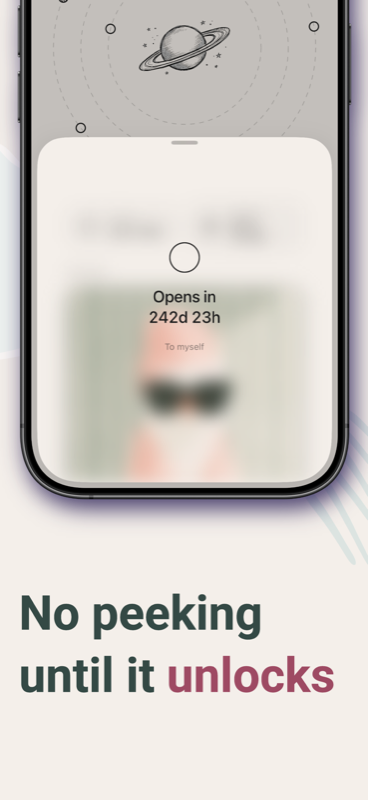
Students with iPhones write their letter in Futura — adding a photo of their desk and a voice note if they like — and seal it to graduation day. It stays blurred until then; the countdown is the only thing visible. Text capsules are free, no grading portal, no accounts for you to manage.
 Get Futura — free
Variations that upgrade the classic
- The ladder: seniors write two letters — one for graduation, one for age 25. The second is the one they'll thank you for.
- Voice edition: a 60-second spoken letter instead of (or on top of) writing — speech students especially; voices date faster than handwriting.
- Class capsule: alongside private letters, one shared letter about "our class right now", opened at the reunion.
- Parents' night tie-in: parents write their own sealed letter to the student for graduation day — see our guide to time capsule letters to your child.
Students who catch the bug can go deeper with the full what-to-write guide — the 10-minute version fits homeroom.